3 communication breakdowns that killed project budgets I've seen
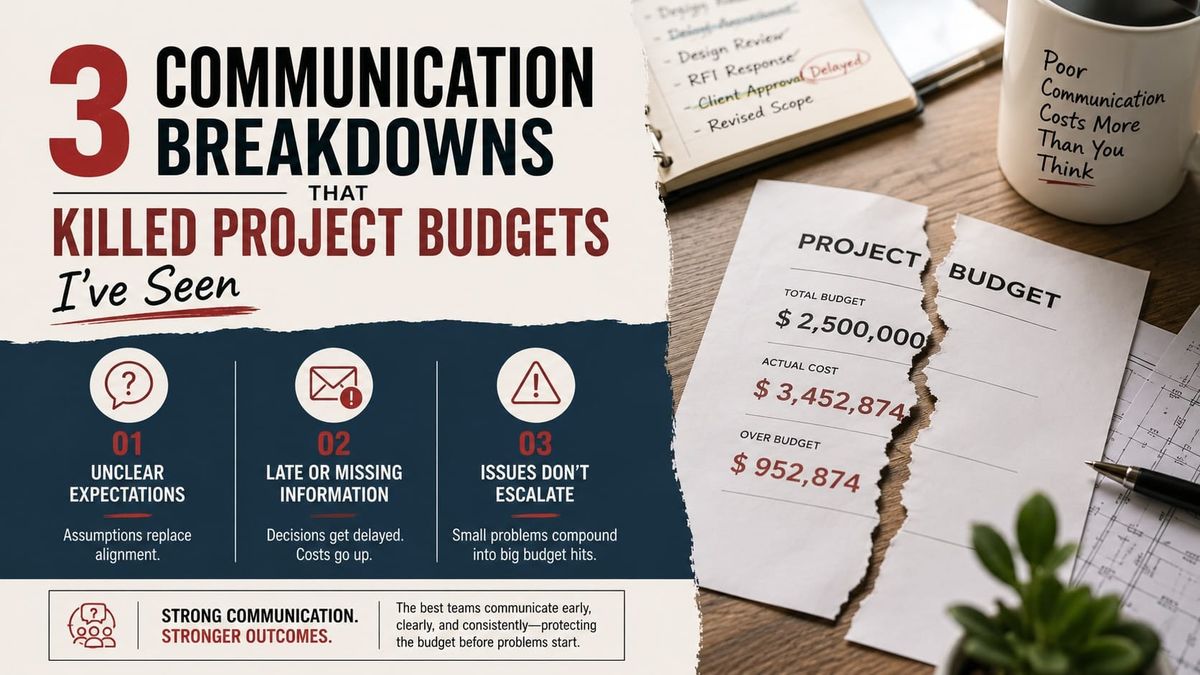
I've been in the construction industry for over 25 years, and I'll tell you something I believe deeply: most budget overruns are communication problems wearing a change order disguise.
The technical problems are real. But they usually get expensive because of how — or whether — they were communicated. Here are three breakdowns I've watched destroy budgets.
Breakdown #1: The contractor assumed. The owner assumed. Nobody confirmed.
A client of mine was building out a restaurant space. During preconstruction, there were conversations about a grease trap — whether it was required, what size, where it would go. Everybody thought somebody else was handling the decision.
Six weeks into construction, the health department inspection revealed the existing grease trap wasn't sufficient. The one they needed required cutting through a concrete slab, rerouting plumbing, and a four-week delay while waiting for inspection sign-off.
Cost: $68,000 and a delayed opening during the prime season.
The original conversation would have taken 45 minutes. The decisions were made — they just weren't documented, confirmed, or acted on.
Breakdown #2: Bad news traveled too slowly.
On a commercial office buildout, the project manager noticed in week three that framing was running behind. Not catastrophically — just 4 or 5 days. He didn't mention it because he thought they could make it up.
They couldn't. The framing delay pushed the MEP rough-in. The MEP delay pushed the insulation and drywall. By week eight, they were 18 days behind. The tenant had already signed a lease starting on a fixed date.
The contractor knew. The owner didn't — until it was too late to resequence the work or add resources without a premium.
Final cost to accelerate and make up time: $112,000.
If the owner had heard "we're 5 days behind" in week three, the conversation would have been uncomfortable. The options would have been real. The outcome would have been different.
Breakdown #3: Scope was discussed but never written down.
An owner I worked with had extensive pre-construction conversations with their GC about what was and wasn't included in the contract. The owner heard "included." The GC heard "allowance" — meaning a placeholder that could change.
On five separate line items, the two parties had different understandings of what was in scope. When the bills came in above those allowances, the GC wrote change orders. The owner refused to pay. Both sides had reasonable grounds for their position, because nothing had been written down clearly.
Three months of disputes, one threat of lien, and $180,000 in contested charges later, they settled in the middle.
The lesson isn't that people are dishonest. It's that construction is complex enough that two smart people can walk away from the same conversation with two different understandings. The written word exists precisely because verbal clarity is an illusion.
The throughline across all three? Someone knew something that the decision-maker didn't know in time to act on it.
That's what I do — make sure the right information gets to the right person before it becomes a $100,000 problem.
Which of these hits closest to home for you? I promise I've seen worse versions of all three.